
// choosing a welding process
MIG vs TIG vs MMA: which welder do you need?
The best process is the one that suits the material, location and finish—not simply the machine with the biggest amperage number. This comparison gets you to a sensible shortlist before you spend money.
The quick answer
| Choose | When it fits best | Main compromise |
|---|---|---|
| MIG/MAG | General fabrication, vehicle work, production and fast learning on mild steel | Needs wire-feed setup and shielding gas; wind can disturb the gas |
| TIG | Fine control, thin material, stainless and aluminium, visible high-quality joints | Slower and more skill-intensive |
| MMA / stick | Site work, repair, heavier steel, awkward access and outdoor jobs | Slag removal, more stops and starts, harder on very thin sheet |
MIG/MAG: the productive all-rounder
A MIG welder continuously feeds wire through the torch. With solid wire, shielding comes from a gas bottle; gasless flux-cored wire carries its own flux system. Once wire size, drive rollers, polarity, voltage and wire speed are right, MIG is quick to learn and quick to use.
It is usually the strongest first choice for mild-steel fabrication, gates, brackets, vehicle repairs and repeated workshop work. You can tack with one hand, make long welds without changing electrodes and move quickly between joints. For thin bodywork, a machine with stable low-end output and a useful wire-speed range matters more than a headline maximum amperage.
Budget for: machine, torch, earth lead, suitable wire, shielding gas and regulator, plus replacement contact tips, liners and shrouds.
TIG: maximum control and clean presentation
TIG welding uses a non-consumable tungsten electrode to form the arc. Filler rod is added separately when needed. That separation gives the welder fine control over the heat and weld pool, which is why TIG is popular for stainless, aluminium, thin tube and joints that will remain visible.
DC TIG covers steels and stainless. Aluminium normally needs an AC/DC machine. Pulse, slope and remote-current controls can be useful, but only after the fundamentals—clean material, correct tungsten preparation, gas coverage and torch control—are right.
Budget for: suitable AC/DC or DC machine, TIG torch, pure argon, regulator/flowmeter, tungstens, cups, collets and matching filler rods.
MMA: simple, portable and site-friendly
MMA—also called stick or arc welding—uses a flux-coated consumable electrode. It needs no separate shielding-gas bottle, so the setup is compact and less sensitive to wind. That makes MMA welders useful for repair, agricultural and site work.
Electrode type and diameter must suit the material, position and available current. MMA copes well with thicker steel, but every electrode change interrupts the weld and the slag must be removed before inspection or another pass. It is possible on thinner metal, but controlling heat and avoiding burn-through takes more practice.
Choose by the job
- First machine for a home or small workshop: MIG is normally the easiest route to useful results.
- Stainless furniture, food-industry work or visible tube: TIG gives the best heat and finish control.
- Aluminium: AC TIG for controlled fabrication; suitably equipped MIG for faster/heavier work.
- Outdoor repair or remote site: MMA avoids a shielding-gas cloud, though safe fume control still matters.
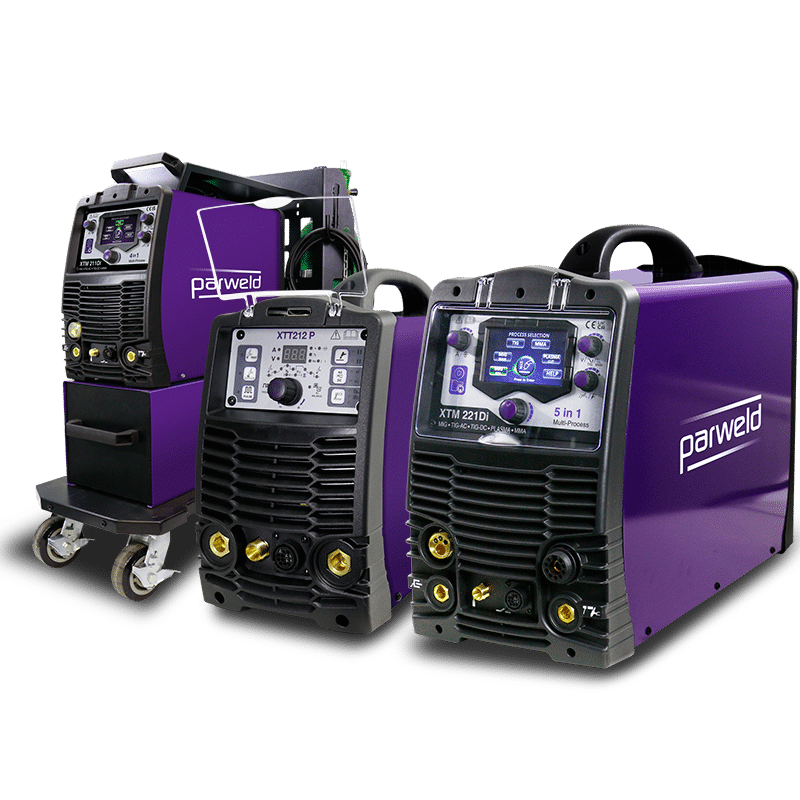
- Mixed work: a multi-process machine can be economical, but check exactly which leads, torch and functions are included.
Fume is a process-selection factor. The HSE says employers should first reduce exposure, then use local exhaust ventilation where practicable and suitable respiratory protection where control is incomplete. Read the HSE welding-fume guidance and assess the actual material, coating, process and work area.
Questions to answer before ordering
- Which metals and thickness range make up most of the work?
- Will you work indoors, outdoors or both?
- Is speed or visible finish more important?
- What single-phase or three-phase supply is available?
- What duty cycle is required at the current you will actually use?
- Are torch, leads, regulator and consumables included and readily replaceable?
Build the right package
Tell us the material, thickness, supply and type of work. We will help match the machine and the consumables it needs.
Keep reading
Next: set up your first MIG welder, choose welding gas and a regulator, or compare helmets, shade control and PAPR.